Friday, 1 April 2011

A new paradigm

 By Khalid Aziz | From the Dawn Newspaper

I RECENTLY saw a TV programme on BBC World that examined the circumstances leading to the declaration of a     `no-fly zone` over Libya.

Such a zone was declared after the adoption of a UN resolution that abridged Libyan sovereignty but supported the aspirations of the Libyans who were protesting and demanding greater freedoms, including an end to Muammar Qadhafi`s four-decade rule.

What was significant in the programme was the lack of direction in many European capitals and in the US preceding this decision. Although there was paralysis at the state level, within a few days the key European countries and the US agreed that action should be initiated under the UN charter.

It was not at all clear what changed the situation from a lack of unanimity to the passage of UN Security Council Resolution 1973, permitting the establishment of a no-fly zone over Libya and warning the Libyan government to stop the use of force against Libyans. In the previous international system such an occurrence was unheard of. So what has changed?

It is now obvious that the international media has become very influential in guiding the policies of western nations, because its reporting creates a demand amongst voters to bring relevant changes. The recent protest movements in the Middle East — one of the most oppressive regions in the world — are clearly the result of two factors: globalisation of values like freedom, human rights and abhorrence of violence; and the availability and popularity of social networking websites.In other words, we are witnessing the birth of international values that are centred on humanism and not on belief-driven ideologies that use force as a weapon.

Secondly, it was surprising for many to see that religion and its votaries did not figure in this new configuration that is taking place in the Middle East, which is mostly Muslim. Will this transform the stereotypes of identities that caused conflict in the past? Or will the future belong to people who follow universal values of human rights while subscribing to local customs as part of their identity?

If it is the latter, then we are likely to see the last of persons like Osama bin Laden and his followers who have caused so much pain and misery everywhere. Life is about peace, love and brotherhood and not winning imaginary ideological or belief-driven battles for a `salubrious` hereafter.

If the media is the new mechanism that shifts voters` perceptions and forces politicians to act in international affairs then what is the message for Pakistan? Evidently, it has to act in such a way that its state policies are acceptable to the global village where humanity dwells and not to act solely for Pakistan`s narrow or selfish ends.

Secondly, it must be ensured that our policies enhance international security while at the same time improve the lives of our people and others around the world. This can only happen if we bring about basic changes in how we manage our internal and foreign policies. At present, the international media narrative portrays Pakistan as part of the problem concerning international security. The criticism against us fills many hours of media time and is dangerous for our long-term survival. So what should Pakistan do?

Winston Churchill provides an answer. He said that if a nation wants to be considered as part of the civilised world, its society must be based on the opinion of civilians. “It means that violence, the rule of warriors and despotic chiefs, the conditions of camps and warfare, of riot and tyranny, give place to parliaments where laws are made, and independent courts of justice in which over long periods those laws are maintained. That is civilisation — and in its soil grows continually freedom, comfort and culture.”

We can judge where we stand by comparing our situation today with what Churchill stated. Pakistan today painfully resembles a citadel of violence and abridged lives, a state that survives on the goodwill of others. Such an enterprise cannot be called civilised under the above definition.

Pakistan`s media is robust and can play a constructive role if there is a wish to do so. However, on issues of freedom and repression the media becomes faint-hearted and selective in its approach. Some recent examples of its reticence are its stance on the repressiveness under the blasphemy laws and the connected tragic deaths of governor Salman Taseer and federal minister Shahbaz Bhatti.

The media acts fearfully because the rightist retribution is instant. For it to remain healthy, it needs to be protected and groomed by the state to become a progressive transformative agent. Its power to do good and take Pakistan out of the grip of terrorists in Swat and Fata was evident when it transformed the mindset of Pakistanis by airing the video that showed the whipping of a girl in Swat by the Taliban in April 2009.

It changed the mindset of the people, which in turn transformed national policy and created a demand for immediate retributive action against the Swat militants — something that the political leadership and the security services were unable to achieve earlier.

This indicates that the Pakistani media can play a major constructive role as a strategic communicator for changing negative attitudes. However, to achieve beneficial results, a sound national strategy is a prerequisite.

It is apparent that in this new media-driven world, Pakistan`s security and future well-being depend on understanding the new emerging information paradigm and aligning security and information strategies accordingly. However, such a strategy cannot be based on denials.

The writer is chairman of the Regional Institute of Policy Research in Peshawar.

Monday, 7 March 2011

As Pakistan battles extremism, it needs allies' patience and help


By Asif Ali Zardari

Sunday, March 6, 2011

Just days before her assassination, my wife, Shaheed Benazir Bhutto, wrote presciently of the war within Islam and the potential for a clash between Islam and the West: "There is an internal tension within Muslim society. The failure to resolve that tension peacefully and rationally threatens to degenerate into a collision course of values spilling into a clash between Islam and the West. It is finding a solution to this internal debate within Islam - about democracy, about human rights, about the role of women in society, about respect for other religions and cultures, about technology and modernity - that shall shape future relations between Islam and the West."

Two months ago my friend Salman Taseer, the governor of Punjab, was cut down for standing up against religious intolerance and against those who would use debate about our laws to divide our people. On Tuesday, another leading member of the Pakistan People's Party (PPP), Shahbaz Bhatti, the minister for minority affairs and the only Christian in our cabinet, was murdered by extremists tied to al-Qaeda and the Taliban.

These assassinations painfully reinforce my wife's words and serve as a warning that the battle between extremism and moderation in Pakistan affects the success of the civilized world's confrontation with the terrorist menace.

A small but increasingly belligerent minority is intent on undoing the very principles of tolerance upon which our nation was founded in 1947; principles by which Pakistan's founder, Quaid-i-Azam Mohammad Ali Jinnah, lived and died; and principles that are repeated over and over in the Koran. The extremists who murdered my wife and friends are the same who blew up the Marriott Hotel in Islamabad and who have blown up girls' schools in the Swat Valley.

We will not be intimidated, nor will we retreat. Such acts will not deter the government from our calibrated and consistent efforts to eliminate extremism and terrorism. It is not only the future of Pakistan that is at stake but peace in our region and possibly the world.

Our nation is pressed by overlapping threats. We have lost more soldiers in the war against terrorism than all of NATO combined. We have lost 10 times the number of civilians who died on Sept. 11, 2001. Two thousand police officers have been killed. Our economic growth was stifled by the priorities of past dictatorial regimes that unfortunately were supported by the West. The worst floods in our history put millions out of their homes. The religious fanaticism behind our assassinations is a tinderbox poised to explode across Pakistan. The embers are fanned by the opportunism of those who seek advantages in domestic politics by violently polarizing society.

We in Pakistan know our challenges and seek the trust and confidence of our international allies, who sometimes lose patience and pile pressure on those of us who are already on the front lines of what is undeniably a long war. Our concern that we avoid steps that inadvertently help the fanatics is misinterpreted abroad as inaction or even cowardice. Instead of understanding the perilous situation in which we find ourselves, some well-meaning critics tend to forget the distinction between courage and foolhardiness. We are fighting terrorists for the soul of Pakistan and have paid a heavy price. Our desire to confront and deal with the menace in a manner that is effective in our context should not become the basis for questioning our commitment or ignoring our sacrifices.

If Pakistan and the United States are to work together against terrorism, we must avoid political incidents that could further inflame tensions and provide extremists or opportunists with a pretext for destabilizing our fledgling democracy. The Raymond Davis incident in Lahore, which directly resulted in the deaths of three Pakistani men and the suicide of a Pakistani woman, is a prime example of the unanticipated consequences of problematic behavior. We need not go into the legal, moral and political intricacies of this case. Suffice it to say that the actions of Davis and others like him inflame passions in our country and undermine respect and support for the United States among our people. We are committed to peaceful adjudication of the Davis case in accordance with the law. But it is in no one's interest to allow this matter to be manipulated and exploited to weaken the government of Pakistan and damage further the U.S. image in our country.

Similarly counterproductive are threats to apply sanctions to Pakistan over the Davis affair by cutting off Kerry-Lugar development funds that were designed to build infrastructure, strengthen education and create jobs. It is a threat, written out of the playbook of America's enemies, whose only result will be to undermine U.S. strategic interests in South and Central Asia. In an incendiary environment, hot rhetoric and dysfunctional warnings can start fires that will be difficult to extinguish.

The writer is president of Pakistan.

Friday, 4 March 2011

George ka khuda hafiz — I & 2


By George Fulton

Published: March 1, 2011

The writer is a freelance print and broadcast journalist george.fulton@tribune.com.pk

For the past nine years, I have been in a dysfunctional relationship. My liaison started somewhat unexpectedly, quickly becoming an all-consuming passionate love affair. My partner reciprocated strongly, bestowing deep affection and adoration upon me. Blinded by love, I was naive to her failings. Yes, at times she was self-destructive, irrational and grossly irresponsible, but I hoped by appealing to her nature’s better angles she could change. Instead, as the years progressed, and, supported by her ‘friends’ in the media, she corroded, simultaneously displaying signs of megalomania and paranoia. Once the relationship turned abusive and I feared for my life, I decide to call it quits. Today, the divorce comes through. Her name is Pakistan. And today, I am leaving her for good.
This was not a difficult decision to make. In fact, I didn’t make the decision. It was made for me. You do not chart your own destiny in Pakistan; Pakistan charts it for you. It’s emigration by a thousand news stories. I am aware that bemoaning the state of Pakistan as a final shot appears churlish and arrogant. After all, I have the luxury to leave — many others do not. Nor do I want to discredit the tireless work of the thousands who remain to improve the lives of millions of Pakistanis. They are better men and women than I. Pakistan has also given me so much over the years. It was Pakistan who introduced me to the love of my life. And it was upon her manicured lawns that we married, and upon her reclaimed soil that we set up our first home. She brought the love of a new family and new friends into my life. And it was Pakistan that witnessed the birth of my son, Faiz — named after one of her greatest sons.
She embraced me like no other gora post-9/11. I appeared in a documentary/reality series titled “George Ka Pakistan”. It allowed me to explore the country. I ploughed fields in the Punjab, built Kalashnikovs in Khyber-Pakhtunkhwa (probably couldn’t do that now), and mended fishing boats in Balochistan. The culmination of the series saw the then prime minister, Shaukat Aziz, confer Pakistani citizenship upon me, after the viewing public voted overwhelmingly to make me one of them. I was their George. Fame and affection followed.
But that love was conditional. Conditional upon me playing the role cast — the naïve gora. The moment I abandoned the Uncle Tom persona and questioned the defined establishment narratives — whether through my television work or columns — excommunication began. No longer a Pakistani in the eyes of others, my citizenship evidently was not equitable to others.
So, as I depart, I could go with my reputation tarnished, but still largely intact. Or I could leave you with some final words of honesty. Well, true love values honesty far more than a feel-good legacy. So here goes.
Pakistan, you are on a precipice. A wafer-thin sliver is all that stands between you and becoming a failed state. A state that was the culmination of a search for a ‘Muslim space’ by the wealthy Muslims of Northern India has ended up, as MJ Akbar recently pointed out, becoming “one of the most violent nations on earth, not because Hindus were killing Muslims but because Muslims were killings Muslims”.
The assassination of Salmaan Taseer saw not only the death of a man but also represented for me the death of hope in Pakistan. I did not mourn Taseer’s death. I did not know the man. But I mourned what he represented — the death of liberal Pakistan. The governor’s murder reminded us how far the extremist cancer has spread in our society. A cancer in which I saw colleagues and friends on Facebook celebrate his murder. A man murdered for standing up for the most vulnerable in our society — a Christian woman accused of blasphemy. He committed no crime. Instead, he questioned the validity of a man-made law — a law created by the British — that was being used as a tool of repression.
In death, the governor was shunned, unlike his killer, who was praised, garlanded and lionised for shooting Taseer in the back. Mumtaz Qadri became a hero overnight. But Qadri is not just a man — he’s a mindset, as eloquently put by Fifi Haroon. Fascism with an Islamic face is no longer a political or an economic problem in Pakistan, it’s now become a cultural issue. Extremism permeates all strata and socio-economic groups within society. Violent extremists may still make up a minority but extremism now enjoys popular support. As for the dwindling moderates and liberals, they are scared.
Pakistan does not require a secret police, we are in the process of turning upon ourselves. But then what do you expect when your military/intelligence nexus — and their jihadi proxies — have used religious bigotry as a tool of both foreign and domestic policy. It is ironic that the one institution that was designed to protect the idea of Pakistan is the catalyst for its cannibalisation. Christians, Ahmadis, Shias and Barelvis have all been attacked in the past year. Who will be next? Groups once funded and supported by the state have carried out many of these attacks. And many jihadi groups still remain in cahoots with the agencies.
So as I leave Pakistan, I leave her with a sense of melancholy. Personally, for all my early wide-eyed excitement and love for the country and its people, Pakistan has made me cynical, disillusioned and bitter over time. I came here with high hopes, adopting the country, its people and the language. I did find redemption here — but no longer.
Published in The Express Tribune, March 2nd, 2011.


From the moment I arrived in Pakistan nine years ago, the omnipotence of the military apparatus was self-evident. Yet, as I leave, it’s apparent it will be this institution, more than any other, that will be the catalyst of this country’s eventual downfall. As Pervez Hoodbhoy recently pointed out, rather than acting as a factor for détente in the region, our acquiring the nuclear bomb in 1998 exacerbated our military arrogance. Kargil, the attack on India’s Parliament and, more recently, Mumbai have all occurred since we got the bomb — attacks that couldn’t have been carried out without some military/intelligence involvement.

And yet, ironically, the military’s regional self-importance belies our chronic servitude to the US. In addition to being the largest landowner in Pakistan, the Pakistani Army is the world’s largest mercenary army. Look at the media storm created over the Kerry-Lugar Bill for it’s supposed slight to Pakistani sovereignty. Yet it is the army’s reliance on US military aid that has made Pakistan a client state of the US. This inherent contradiction is not disseminated in the media. Instead, the established narrative for our acquiescence to the US is laid firmly at the weakness of our political class. As if it was the politicians — and not the military leadership — who somehow control Pakistan’s foreign policy.

Of course the military/religious right in Pakistan use their proxies in the media to blame the Hindus, Americans and Jews for all our sins. But those sins are mostly ours. Atiqa Odho, a friend, and someone who truly wants the best for Pakistan, sent me a text message after the detention by India customs of singer Rahat Fateh Ali Khan. “Rahat Ali Khan is not a criminal, he has become a victim of corrupt trade practices in India that have singled him out to target the soft image of Pakistan… Let’s not treat a music icon who has million of fans over the world as a common criminal.” The text had it all: hyper-patriotism, paranoia, absolution of responsibility, and a shot of snobbery. Why shouldn’t he be treated as a common criminal if he was avoiding tax? The attack on the Sri Lanka cricket team wasn’t a foreign hand. It was a Pakistani hand. Salman Butt, Mohammed Asif and Mohammed Amir were not brought down by some covert Anglo/India plot, but by their own avarice. They cheated.

But the right’s hyper-nationalism is perhaps more tolerable than the liberal elite’s disengagement and insouciance. Like the right, the liberal elite believe all Pakistan’s woes belong to others. But rather than the Hindu/US/Zionist paranoia of the right, the liberals put the blame on the mullahs, the masses, the uneducated and the unwashed — anyone, but themselves. We — and I include myself here, as this was my social milieu for the past nine years — are unaware of our own hypocrisy.

My friends will condemn the cricketers, but not the society that actively encourages these lower middle-class boys to cheat. But why would they? Their families have gorged and benefitted from this society. Recently, at a coffee shop, I overheard a society Begum, decked out in designer clothes and glasses, bemoan the cricketing scandal. Her ire was primarily directed at the boys for bringing Pakistan’s ‘good’ name into disrepute — not the cheating itself. She then harked back to a time when the Pakistan cricket team spoke English well, as if good English equalled with moral rectitude. But does she question how her husband makes his money? For every Rs100 collected by the Federal Board of Revenue (FBR) in taxes, it misses another Rs79 due to tax evasion. The FBR estimates that the total revenue lost by the government as a result of tax evasion comes out to Rs1.27 trillion for this fiscal year and is equal to eight per cent of the GDP. According to the FBR, over 70 per cent of all taxes evaded are corporate income taxes. What’s the difference between Salman Butt screwing his country for money and the rest of us?

But the liberal elite is a misnomer. We aren’t really liberal. We want the liberal values of free speech and rule of law, without wanting to instil the economic and democratic mechanisms to ensure them. We espouse liberalism but don’t practice the egalitarian values — distribution of power and wealth — that underpin liberalism.

But then, the English liberal ‘elite’ has abdicated all responsibility to govern in the past 60 years. Despite enjoying unprecedented levels of wealth and education, we no longer believe it is our duty as the best educated and most privileged in society to contribute to its development. The English language has created a linguistic Berlin Wall between us and the rest of the country. We remain cosseted inside our bubble. Instead, we have ceded political space to a reactionary, conservative, military, feudal and religious nexus. Tolerating this because, in turn, they have left us alone. They have allowed us freedoms that the rest of the country doesn’t have.Freedom to get obscenely wealthy. Freedom to party at Rs10,000-a-ticket balls. Freedom to dress how we like. But these freedoms come at a price. A Faustian pact has been signed.

Even Pakistan’s intellectual elite has largely abandoned its responsibility. An ideological vacuum occurred after 1971, when the ‘idea of Pakistan’ and the two-state solution failed. What filled the vacuum over the succeeding decades have been a variety of parties with their own vested self-interests — Ziaul Haq, Islamists, the Saudis and the US — trying to enforce their own idea of Pakistan. Today, our intellectual elite are too compromised — suckling on the teat of donor money, scholarships and exchange programmes — to challenge the US narrative.

Unfortunately, no one is immune to the ills that this country subjects its citizens to. I have changed. Slowly, my values and morals have corroded. But I don’t want that for my one-year-old boy, Faiz. I want him to grow up in a society where guns are not an everyday occurrence and his parents can openly hold hands.

After Salmaan Taseer’s assassination, my mother-in-law — a hardworking, decent school principal, who was born in Bombay and had grown up in Dhaka before migrating to Pakistan — called me up. She had seen three of her children leave Pakistan during the past 20 years. My wife was the last one remaining. As she spoke, she sounded defeated: “George, just jao. Jao”. So now I am going. Khuda hafiz, Pakistan.

Published in The Express Tribune, March 3rd, 2011.

Saturday, 26 February 2011

US-Pakistan Military Leaders Secretly Decide to Kick Zardari-Gilani Tyranny Out of Power?

- Special Report

U.S., Pakistan military chiefs hold secret talks in Oman

By Kevin Baron

Muscat, Oman, 23 February 2011 (Stars and Stripes) - Several of the most senior leaders of the U.S. military, the Afghanistan War, and the Pakistani armed forces held a daylong secret meeting Wednesday [23 February 2011] at a secluded luxury resort along the Omani shores of the Persian Gulf.

One U.S. official in attendance described the meeting as "very candid and cordial, and very productive discussions."

Sunburned European tourists splashed about just yards away from a closely guarded conference room in which US Admiral Mike Mullen, Chairman of the Joint Chiefs of Staff; US General David Petraeus, Commander of International Security Assistance Force (ISAF); US Admiral Eric Olson, Commander of U.S. Special Operations Command; and US Marine Corps General James Mattis, Commander of U.S. Central Command, met with [CIA Actor] General Ashfaq Parvez Kayani, Pakistan's Chief of Army Staff; and Major General Javed Iqbal, [Pakistan Army] Director General of Military Operations; Brigadier Muhammad Saeed of the Pakistan Army].


"I was very grateful for [CIA Actor] General Kayani's time and the opportunity to continue the dialogue and the relationship at this very critical time in the effort," Mullen told reporters traveling with him.

The meeting, planned several months ago, is the third such gathering of high-level American and Pakistani officials since August 2008 to discuss the [illegal] war, according to a military official in the U.S. party.

"I was pleased to have the opportunity to discuss with American officers the progress we have made fighting [Pakistanis] in our country and to offer them my thoughts about how our two sides might better cooperate," [CIA Actor] Kayani said, in a statement released Wednesday by Pakistan's military. "Pakistan's [mercenary/rented] soldiers have fought bravely [against Pakistani and Afghan civilians/ citizens for American dollars, British pounds and foreign money] and accomplished much at great cost. We must honor those sacrifices by making sure our military operations are understood."

Both sides gave operational updates and emphasized the need for better cross-border communication, information-sharing and physical infrastructure development, such as roads, according to both parties.

No other details were provided.

With attention focused on the [Asian] region's uprisings, Mullen is on a long-scheduled Persian Gulf tour that also has touched down in Saudi Arabia, Qatar and the United Arab Emirates, with plans to visit Djibouti, Bahrain and Kuwait before returning to Washington.

U.S.-Pakistani relations on the whole have improved on many fronts since 2009. In the past two years, the Obama Administration and military leaders have praised Pakistan for sending 140,000 [rented/ mercenary Pakistani] troops to fight the [civilians/citizens of Pakistan and Afghanistan], "terrorists" and other insurgent groups along its border regions with Afghanistan.

But in 2010, Pakistan stalled its advances citing heavy losses and needing time to renew its [mercenary/rented] forces. Meanwhile, the U.S. has increased its use of [unlawful] drone strikes to kill [innocent Pakistanis] inside Pakistan. The strikes, however, remain largely unpopular among Pakistanis. An editorial in Pakistan's [pro- Zardari-Gilani Mafia] "Daily Times" questioned the efficacy of imprecise [illegal] drone strikes, concluding: "The political fallout of blunt attacks will not achieve the purpose of winning hearts and minds of the [Pakistani] people in the counter-insurgency [or imperialistic terrorism] efforts of the U.S."

Additionally, relations between U.S. and Pakistani intelligence services are at their lowest in years, to the point of missing chances to target senior [Pakistanis and Afghans], The [pro-Zionism] Wall Street Journal reported on Friday. Any deterioration could endanger U.S. troops who frequently confront Pakistan-based [Pakistanis] and insurgent [freedom] fighters sent into Afghanistan.

Pakistan's Inter-Services Intelligence (ISI) has stopped giving US CIA drone operators information to target [innocent Pakistanis] inside Pakistan, according to the [pro-Zionism] Journal, including those with the notorious [Zardari-Gilani] Haqqani network the ISI has long supported.


Read: Zardari's Foreign Contracted Cons

By Pakistani noted journalist Dr. Shahid Qureshi:

- http://www.thelondonpost.net/Feb14201100021.html

In December [2010], US CIA's station chief ["Jonathan Banks"] was outed publicly, forcing him to leave Pakistan. And this week, tensions heightened further as it was revealed former [US Army] Special Forces soldier Raymond [Allen] Davis, who is accused of shooting two Pakistani men in Lahore [Pakistan], he said were trying to rob him, was working for the US CIA at the time. [US War Criminal] President Barack Obama and other U.S. officials [falsely and fraudulently] insisted he was a [US] diplomat in efforts to win his release.

http://groups.google.com/group/pressforum/t/83fcee93eab64acd

Moreover, in November [2010], news accounts of U.S. diplomatic cables revealed by WikiLeaks confirmed small numbers of U.S. special operations forces had been operating on the ground inside Pakistan's borders [with the illegal authorization of CIA Actor Asif Ali Zardari, CIA Actor Yousuf Raza Gilani and CIA Actor Abdul Rehman Malik].

In [US] Congress last week, [US War Criminal Robert Michael] Gates said Pakistan is a "mixed picture....and it is something we just need to keep working at."

Mullen, at the same hearing, praised Pakistan's [mercenary/rented] military performance, but worried about many other factors from the struggling economy to the stream of [Pakistanis and Afghans] flocking there.

"The vector is going in the wrong direction overall for the country.

We are very unpopular there," he said. "...I am as concerned as I have ever been."

Mullen, for his part, has made it a personal mission to try and bend Pakistan toward U.S. views, making more than 20 trips to visit  Kayani during his term as the top U.S. military officer and senior military advisor to the President.

"The Chairman believes this kind of dialogue is vital to improving coordination and communications between our two militaries," the official said. "He believes [the Pakistan (rented/mercenary) military] continues to do a remarkable job battling [Pakistanis] inside their borders."

Friday, 25 February 2011

Two CIA contractors spirited out of Pakistan

Reuters

NEWS

Wed, Feb 23 15:42 PM EST

By Mark Hosenball

WASHINGTON (Reuters) - Two U.S. citizens with diplomatic status were quietly withdrawn from Pakistan after being involved in a fatal car accident last month while trying to help Raymond Davis, a CIA contractor being held by Pakistani authorities on murder charges.

Two officials familiar with U.S. government activities in Pakistan said the two Americans who left the country worked for the CIA under contract as protective officers. This means they were employed as highly skilled bodyguards, like Davis, for CIA operations officers serving in Pakistan.

The two Americans who left Pakistan have not been otherwise identified by U.S. or Pakistani authorities. The CIA declined to comment.

According to a translated Pakistani police statement obtained by Reuters, the two Americans got into the car crash while trying to go to the aid of Davis, who U.S. sources say claims he shot dead two Pakistanis on a motorcycle when they tried to rob him at gunpoint as he was driving in Lahore.

The police report says the vehicle used by the unidentified Americans, a Landcruiser belonging to the U.S. consulate in Lahore, drove the wrong way down a one-way street.

It struck and killed a motorcyclist named Muhammad Ibad-ur-Rehman, the report said, and "fled from the scene of the incident."

The two U.S. officials confirmed media reports the two men involved in the fatal accident were working and living in the same building in Lahore as Davis. They said all three men were working on similar security assignments for the CIA.

Pakistani officials and news reports have said items recovered from Davis included a telescope, a 9mm pistol and a camera containing pictures of bridges and religious schools known as madrassas.

Current and former U.S. national security officials familiar with the role of CIA "protective officer" contractors say it would be routine for them to do reconnaissance missions to chart safe travel routes and spot security threats.

U.S. officials deny media reports that Davis was involved in some kind of undercover counter-terrorism operations.

They also deny reports from Pakistan suggesting that Davis' assailants had some link to the Inter Services Intelligence directorate, Pakistan's principal intelligence agency.

Elements of the ISI have been involved in secretly supporting U.S. counter-terrorism operations in Pakistan, including a long-running campaign to attack suspected militant camps using missiles fired from unmanned drone aircraft.

(Additional reporting by Mubasher Bokhari in Lahore; Editing by John O'Callaghan and Philip Barbara)

Pakistan's intelligence ready to split with CIA

By KATHY GANNON and ADAM GOLDMAN, Associated Press – Wed Feb 23, 5:32 pm ET

ISLAMABAD, Pakistan – Pakistan's ISI spy agency is ready to split with the CIA because of frustration over what it calls heavy-handed pressure and its anger over what it believes is a covert U.S. operation involving hundreds of contract spies, according to an internal document obtained by The Associated Press and interviews with U.S. and Pakistani officials.

Raymond Allen David

Such a move could seriously damage the U.S war effort in Afghanistan, limit a program targeting al-Qaida insurgents along the Pakistan frontier, and restrict Washington's access to information in the nuclear-armed country.

According to a statement drafted by the ISI, supported by interviews with officials, an already-fragile relationship between the two agencies collapsed following the shooting death of two Pakistanis by Raymond Davis, a U.S. contracted spy who is in jail in Pakistan facing possible multiple murder charges.

"Post-incident conduct of the CIA has virtually put the partnership into question," said a media statement prepared by the ISI but never released. A copy was obtained this week by the AP.

The statement accused the CIA of using pressure tactics to free Davis.

"It is hard to predict if the relationship will ever reach the level at which it was prior to the Davis episode," the statement said. "The onus of not stalling this relationship between the two agencies now squarely lies on the CIA."

The ISI fears there are hundreds of CIA contracted spies operating in Pakistan without the knowledge of either the Pakistan government or the intelligence agency, a senior Pakistani intelligence official told the AP in an interview. He spoke only on condition he not be identified on grounds that exposure would compromise his security.

Pakistan intelligence had no idea who Davis was or what he was doing when he was arrested, the official said, adding that there are concerns about "how many more Raymond Davises are out there."

Davis was arrested Jan. 27 in Lahore after shooting two Pakistanis. A third Pakistani was killed by a U.S. Consulate vehicle coming to assist the American. Pakistan demanded the driver be handed over, but the AP has learned the two U.S. employees in the car now are in the United States.

Davis has pleaded self-defense, but the Lahore police upon completing their investigation said they would seek murder charges. The ISI official told the AP that Davis had contacts in the tribal regions and knew both the men he shot. He said the ISI is investigating the possibility that the encounter on the streets of Lahore stemmed from a meeting or from threats to Davis.

U.S. officials deny Davis had prior contact with the men before the incident, and CIA spokesman George Little said any problems between the two agencies will be sorted out.

"The CIA works closely with our Pakistani counterparts on a wide range of security challenges, including our common fight against al-Qaida and its terrorist allies," he said. "The agency's ties to ISI have been strong over the years, and when there are issues to sort out, we work through them. That's the sign of a healthy partnership."

The CIA repeatedly has tried to penetrate the ISI and learn more about Pakistan's nuclear program. The ISI has mounted its own operations to gather intelligence on the CIA's counterterrorism activities

The ISI is now scouring thousands of visas issued to U.S. employees in Pakistan. The ISI official said Davis' visa application contains bogus references and phone numbers. He said thousands of visas were issued to U.S. Embassy employees over the past five months following a government directive to the Pakistan Embassyin Washington to issue visas without the usual vetting by the interior ministry and the ISI. The same directive was issued to the Pakistan embassies in Britain and the United Arab Emirates, he said.

Within two days of receiving that directive, the Pakistani Embassy issued 400 visas and since then thousands more have been issued, said the ISI official. A Western diplomat in Pakistan agreed that a "floodgate" opened for U.S. Embassy employees requesting Pakistani visas.

The ISI official said his agency knows and works with "the bona fide CIA people in Pakistan" but is upset that the CIA would send others over behind its back. For now, he said, his agency is not talking with the CIA at any level, including the most senior.

To regain support and assistance, he said, "they have to start showing respect, not belittling us, not being belligerent to us, not treating us like we are their lackeys."

NATO and U.S. operations in Afghanistan could be adversely effected by a split between the ISI and the CIA. Washington complains bitterly about Pakistan's refusal to go after the Pakistani-headquartered Haqqani network, which is believed to be the strongest fighting force in Afghanistan and closely allied with al-Qaida.

The ISI official said Pakistan is fed up with Washington's complaints, and he accused the CIA of planting stories about ISI assistance to the Haqqani network.

Relations between the CIA and ISI have been on a downward slide since the name of the U.S. agency's station chief in Pakistan was leaked in a lawsuit accusing him of killing civilians in a drone strike.

Fearing for his safety, the CIA eventually pulled the station chief out of the country. ISI leaders balked at allegations that they outed the CIA top spy in their country. Former and current U..S. officials believe the station chief fell out of favor, but the Pakistanis say this is not the case

Those accusations and the naming of ISI chief Shujah Pasha in a civil lawsuit in the United States — filed by family members of victims of a November 2008 attack in Mumbai, India, by insurgents — started the downslide in relations, the ISI official said.

To help repair the crucial relationship, the CIA earlier this year dispatched a very senior officer to be the new station chief who was previously the head of the European Division, one of the most important jobs in the National Clandestine Service, the agency's spy arm.

The spy agencies have overcome lows before. During President George W. Bush's first term, the ISI became enraged after it shared intelligence with the United States, only to learn that the then-CIA station chief passed that information to the British. The incident caused a serious row, one that threatened the CIA's relationship with the ISI and deepened the levels of distrust between the two sides. At the time Pakistan almost threw the CIA station chief out of the country.

Monday, 21 February 2011

CIA Spy Captured Giving Nuclear Bomb To Terrorists


Posted by EU Times on Feb 11th, 2011 Listen to this article. Powered by Odiogo.com

While all eyes in the West are currently trained on theongoing revolution taking place in Egypt, Russia’s Foreign Intelligence Service (SVR) is warning that the situation on the sub-continent has turned “grave” as it appears open warfare is about to break out between Pakistan and the United States.

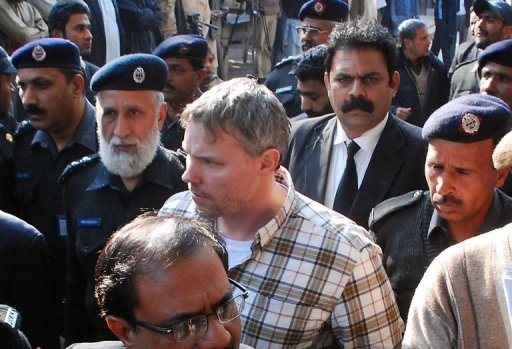
Fueling this crisis, that the SVR warns in their report has the potential to ignite a total Global War, was the apprehension by Pakistan of a 36-year-old American named Raymond Allen Davis (photo), whom the US claims is one of their diplomats, but Pakistani Intelligence Services (ISI) claim is a spy for the Central Intelligence Agency (CIA).

Davis was captured by Pakistani police after he shot and killed two men in the eastern city of Lahore on January 27th that the US claims were trying to rob him.

Pakistan, however, says that the two men Davis killed were ISI agents sent to follow him after it was discovered he had been making contact with al Qaeda after his cell phone was tracked to the Waziristan tribal area bordering Afghanistan where the Pakistani Taliban and a dozen other militant groups have forged a safe haven and former CIA agent Tim Osman (also known as Osama bin Laden) is believed to be in hiding.

Of the actual gunfight itself we can read as reported by the Time News Service which, in part, says:

“The scene could have been scripted in a Hollywood action thriller: For two hours at the end of last month in Lahore, U.S. diplomat Raymond Davis was closely pursued by two visibly armed men on a motorbike. He noticed them tailing him from a restaurant to an ATM, and through the crowded streets of Pakistan’s second [largest] city. They were close by when, in a crowded intersection, Davis produced his own handgun and fired seven shots.

The diplomat was apparently a crack shot, and all seven bullets found their mark, killing his two pursuers. Davis then called for back-up, and a four-wheel-drive vehicle raced onto the scene, striking a Pakistani bystander who was killed by the impact. But the people in the vehicle, whose identities remain unknown, escaped from the scene having failed to retrieve Davis, who was later arrested nearby.”

The combat skills exhibited by Davis, along with documentation taken from him after his arrest, prove, according to this report, his being a member of the feared American Task Force 373 (TF373) black operations unit currently operating in the Afghan War Theater and Pakistani tribal areas comprised of US Military Special Forces Soldiers, CIA spies and freelance mercenaries.

Further information about Davis discovered by the Times of India includes:

“According to records from the Pentagon, Davis is a former Special Forces soldier who left the army in August 2003 after 10 years of service. A Virginia native, he served with infantry divisions prior to joining the 3rd Special Forces Group in Fort Bragg, North Carolina. In 1994, he was part of the U.N. peacekeeping force in Macedonia. His record includes several awards and medals, including for good conduct.

Public records also show Davis runs a company with his wife registered in Las Vegas called Hyperion Protective Services, though it was not immediately clear whether the company has had many contracts with the U.S. government.”

Since Davis’s capture the US has exerted extraordinary pressure upon Pakistan to release him, including the American Ambassador warning President Asif Ali Zardari to release him “or else” and the cancellation of all talksbetween these two nuclear powered Nations.

Today, according to this SVR report, this most critical of situations became even worse when a Pakistani judge refused to bow to American pressure and ordered a further 14-day detention of Davis, and which sparked an immediate threat from US National Security Advisor Tom Donilon, who told Pakistani envoy Hussain Haqqani that the Obama administration will “kick him out of the US”, close American consulates in Pakistan and cancel President Zardari’s upcoming visit to Washington if their CIA spy wasn’t released immediately.

Fearing that the conflict over Davis may lead to open warfare, the Pakistanis were quick to let the Americans know they would not come out any conflict unscathed with their firing yesterday of their new Hatf-VII nuclear cruise missile (also called Babur after the 16th-century Muslim ruler who founded the Mughal Empire) that Major General Athar Abbas said “…can carry strategic and conventional warheads, has stealth capabilities, is a low-flying, terrain-hugging missile with high manoeuvrability, pinpoint accuracy and radar avoidance features”.

The United States Institute for Science and International Security (ISIS) further reported yesterday that Pakistanappears to be building a fourth military nuclear reactor, signaling its determination to produce more plutonium for atomic weapons.

Most ominous in this SVR report, though, is Pakistan’s ISI stating that top-secret CIA documents found in Davis’s possession point to his, and/or TF373, providing to al Qaeda terrorists “nuclear fissile material” and “biological agents” they claim are to be used against the United States itself in order to ignite an all-out war in order to reestablish the West’s hegemony over a Global economy that is warned is just months away from collapse.

Not known to the masses of the American people is that the $20 Trillion they have spent on their longest wars in history has bankrupted their Nation to such an extent that the International Monetary Fund (IMF) called yesterday for replacement of the US Dollar as the World’s reserve currency.

More crucially that the American people are ignoring is the fact that their own government has unleashed against them a 21st Century update to the dreaded US Military “Operation Northwoods” campaign of terror designed to enrage them to accepting war as their main way of life.

Operation Northwoods was a series of false-flag operation proposals that originated within the United States government in 1962. The proposals called for the CIA, or other operatives, to commit acts of terrorism in US cities and elsewhere. These acts of terrorism were to be blamed on Cuba in order to create public support for a war against that nation, which had recently become communist under Fidel Castro. One part of Operation Northwoods was to “develop a Communist Cuban terror campaign in the Miami area, in other Florida cities and even in Washington.”

Operation Northwoods proposals included hijackings and bombings followed by the introduction of phony evidence that would implicate the Cuban government. It stated:

“The desired resultant from the execution of this plan would be to place the United States in the apparent position of suffering defensible grievances from a rash and irresponsible government of Cuba and to develop an international image of a Cuban threat to peace in the Western Hemisphere.”

Several other proposals were included within Operation Northwoods, including real or simulated actions against various US military and civilian targets. The plan was drafted by the Joint Chiefs of Staff, signed by Chairman Lyman Lemnitzer and sent to the Secretary of Defense. Although part of the US government’s Cuban Project anti-communist initiative, Operation Northwoods was never officially accepted and the proposals included in the plan were never executed.

James Bamford summarizes Northwoods as follows:

“Operation Northwoods, which had the written approval of the Chairman and every member of the Joint Chiefs of Staff, called for innocent people to be shot on American streets; for boats carrying refugees fleeing Cuba to be sunk on the high seas; for a wave of violent terrorism to be launched in Washington, D.C., Miami, and elsewhere. People would be framed for bombings they did not commit; planes would be hijacked. Using phony evidence, all of it would be blamed on Castro, thus giving Lemnitzer and his cabal the excuse, as well as the public and international backing, they needed to launch their war.”

Though Operation Northwoods had the “approval” of the Chairman and every member of the Joint Chiefs of Staff, it did not have the approval of their boss, President John F. Kennedy (1917-1963), but who barely one year after his outright rejection of this monstrous plan to kill thousands of innocent Americans was gunned down as an example to any future US leader what would happen to them if they dared go against the wishes of the Military-Industrial Complex (MIC).

Today, as the US Department of Homeland Security has just issued a grim warning that the threat of terror strike on America is at a higher level than it has been since September 11, 2001, and the WikiLeaks release of secret US government cables reveals that al Qaeda is on the brink of using a nuclear bomb, a new President stands between his people and the CIA warmongers with the only question being will he protect them like Kennedy did?

The answer to that question, sadly, appears to be “no” as new information recently obtained by US journalists show that not only has Obama failed to discipline those CIA officers who have led the United States to near total collapse, he has promoted them in numbers never before seen in history.

Sunday, 20 February 2011

An imperial hubris


By: Shireen M Mazari


Once again Pakistan is being subject to the usual US imperial arrogance – this time on the Davis case. We have had threats of all kinds simply to get a murderer released and even President Obama has jumped into the fray, imperially claiming Davis has diplomatic immunity! Of course US Presidents, in recent times at least, have been known for their lies with Bush commencing his Iraq war on the WMD lie and Colin Powell brazenly lying to the UN Security Council! So Obama may be following yet another Bush tradition – after his exuberant adoption of the drones’ policy. Such imperial hubris reflected in the threats of aid and meetings’ cut-offs should be seen as an opportunity by the Pakistani state to re-evaluate its whole relationship with the US and restructure it more favourably.

If the whole “strategic” edifice is under threat over the issue of Raymond Davis, one really wonders whether there ever was such a relationship to begin with. Take the example of our longstanding strategic ally China: has this relationship ended despite the targeted killings of Chinese in Pakistan?


Perhaps if the US could see beyond its imperial arrogance, it would realise that right now its own interests would be damaged far more than the suffering the Pakistani nation may suffer – as opposed to the ruling elite – especially in terms of its so-called “war on terror”! But the US rarely sees reality beyond its blinkered vision and its contemptuous arrogance towards the Pakistani state is so immense that it has chosen not to have a lawyer represent Davis in the Lahore High Court!


It is also amusing and ironic to see the Obama Administration, as well as US lawmakers, suddenly accuse Pakistan of not abiding by international law! Given how the US not only flouts international law at every opportunity but refuses to subscribe to accept the International Criminal Court and any International Court of Justice Advisory Opinion that goes against it (Remember the Nicaragua harbour mining case?), it is hardly in a position to adopt the high moral ground on international law.

Only recently, the US violated the Non Proliferation Treaty (NPT) it had put its signature to, when it signed its nuclear deal with India – something Senator Kerry felt he should educate us on in terms of the Vienna Conventions. By going for this deal the US contravened Articles I and III:2 of the NPT, which amongst other restrictions, forbid transfer of sensitive and dual use technology to non-NPT states.


However, what is the Pakistan government up to with its Ministry of Foreign Affairs seeking three weeks further to give a simple response to the issue of Raymond Davis’s immunity issue? As if the absurd proclamations and retractions of the PPP office bearers and ministers were not folly enough, we have now had the Punjab Chief Minister state that Interior Minister Rehman Malik had informed him that the Federal Government was going to give Davis diplomatic immunity and would be informing the Lahore High Court of the same.

Clearly that too did not happen on Thursday as the case got underway and the nation must be grateful for these small hiccups in the path of total subjugation to the US Will. Unfortunately, the LHC has had to stay the proceedings till the federal government overcomes its habitual pusillanimity when confronted by the US and plucks up the courage to take a clear position on the immunity issue.


But why is the Pakistani political leadership so hesitant on the Davis case since whichever legal perspective one takes, there is no ground on which Davis can claim diplomatic immunity. In view of the documents already in the public domain, including the “official visa” – and there is a qualitative difference between his visa and a diplomatic visa – there is no ground on which Davis could be placed in the category of a diplomat. However, even if one were to concede the US argument of his being “Administrative and technical staff” and thereby entitled to “diplomatic immunity” under the 1961 Vienna Convention; for such staff this “immunity” is not applicable to actions outside “official functions” under Articles 31:1c and 37:2.


In any case, with the material evidence, including photographs of sensitive military offices, recovered from Davis as well as his pay slip for the period beginning September 2010, he clearly falls into the category of being hired by the US State Department’s Bureau of Diplomatic Security and is in all probability a CIA “stringer” intelligence agent. In fact, as the facts of Davis come to light, it appears he may have deliberately allowed the second car to speed away as it may have had more covert operatives in it. Interestingly, in November 2009 and later in 2010, Davis was caught in restricted military locations in Peshawar and sources state that the Foreign Office verbally asked the US Embassy to remove him from Peshawar. Proper interrogation of Davis is essential now for Pakistan to discover the linkages with a range of US covert activities.


While we can sigh with relief over the halt in drone attacks since the arrest of Davis, the cause for this halt is probably the US fear that the location of other stringer agents may be revealed through these attacks. That brings up another interesting aspect of the Davis case: the possibility of charging him with espionage given the massive evidence already available and made public.

After all, if the federal and provincial governments manage to persuade, through fair means or foul, the families of the victims to accept “blood money”, Davis still needs to be detained on espionage charges and tried for the same. This is one criminal who must not be allowed to get away with impunity.


Most important, though, the Davis case should persuade the Pakistani state to rein in the thousands of US operatives – both CIA and private security contractors – and rid the country of them as soon as possible so that there is no repeat of this lethal incident again on our territory.
(The writer is a former editor of The Nation and ex-head of the Institute of Strategic Studies in Islamabad).

Friday, 11 February 2011

The Tell Tale Heart: The Smiling Assassin - Mehreen Aziz Khan

A gut reaction of hatred engulfs me when I see the triumphant face of Qadri, Governor Salman Taseer’s bodyguard who shot him so cold bloodedly on Tuesday evening at Islamabad’s Kohsar market. To my liberal-minded, upper-middle class psyche, this Qadri stands for everything that I currently hate about my increasingly Talibanized and radicalized country. Violence in the name of religion, maddening intolerance, crippling narrow-mindedness, annoying self-righteousness.

But after some soul-searching, I realise that I think the way I do because of my relatively privileged life experiences. My family and I have never known poverty. We are relatively well read, well travelled and have had the opportunity to receive a well-rounded education. I am currently living in a first world country with a very cushy lifestyle.

Its all very well for me and others like myself to read the headlines and register our outrage and anger against the ‘inhuman’, ‘brutal’, ‘disgusting’ man who shot Taseer, and the equally ‘misguided’ and ‘abhorrent’ religious right that is applauding the killer and declaring him a hero. It defies what to our minds is well-reasoned logic about the ‘true message of Islam’ and shakes our ‘moderate’, ‘tolerant’ selves to the core. How could our country come to this? What’s going to become of us? And once again, as the battle lines are drawn across social media platforms like Twitter, Facebook, blogs and opinion forums between those who are condemning the killing and those who are celebrating it, the widening chasm that exists between the two diagrammatically opposed ideological groups becomes even more painfully clear. And its posing a threat to our very co-existence as a nation.

The background story to the killing seems straightforward enough. A poor Christian woman became the latest victim of the (outrageously unjust) blasphemy law. Governor Taseer, unusually one of the most controversial and widely derided political leaders of the country, found a soft spot for her plight, and became a champion for her rights. For once he was not making headlines because of corruption, self-serving politics or lavish lifestyle, but standing up for the downtrodden. This made him a target of the ‘mullah brigade’ who drummed up their usual hate-mongering vitriol and issued angry fatwas. But the Governor’s stance resonated with us - the ‘liberal’ and ‘educated’ segment of society, who could identify with his sentiments and are finding overt Islamization a threat to our Western-influenced lifestyles and belief systems. We might consider ourselves patriotic Pakistanis and proud Muslims, but there is no denying the heavy influence of the West in things that shape our opinions, like our education and media consumption (books, magazines, movies, music, television, internet etc.), as opposed to the lower middle class and working class, which have a more indigenous viewpoint about things.

So with such widely differing influences and life experiences at play, it’s only fair to ask: Is demonising Qadri and his huge number of followers a constructive approach on our part?

Aren’t we guilty of being as intolerant as the group we are so eloquently condemning since the past few days?

Aren’t we being as small-minded as the Americans who divide humanity into ‘us’ and ‘them’ and indiscriminately bomb countries and citizens without addressing the root cause of the resentment in those parts of the world?

Shouldn’t we think about what makes a ‘Qadri’ in the first place?

I believe its simplistic to think his ideological opposition to Salman Taseer’s blasphemy law stance was the only reason that caused him to pummel 20 rounds of ammunition into the chest of the man he had been recruited by the state to protect.
Is he not the product of the complex matrix of the region’s geopolitics, the warped ‘war on terror’, the cruel policies of the West and their cohorts that pan the fires of resentment in the local people? Not to mention a reaction to the self-serving elite of our country whose corruption and greed knows no end and who would never part with a penny to help their poor fellow countrymen.

And poverty and deprivation and social injustice all play a role. Back in 2005 when I was working with a media company in Islamabad, I worked on a documentary about police reforms. I remember visiting the living barracks of the Punjab’s Elite Force Guard, the outfit that Qadri belonged to. They were housed in a makeshift ancient Hindu mandir and there was certainly nothing ‘elite’ about the place. These guys, clearly the cream of the police crop in terms of fitness, training and ability – were sitting around swatting flies in the stifling heat, made to live in a place barely fit for animals to live in.

What kind of life-prospects do men like Qadri and their families have to look forward to? They are the ‘have-nots’, and as the country plummets deeper into economic crises and basic amenities become harder to afford and access, the extravagant lives of the ‘haves’ must be becoming harder to stomach. It should come as no surprise that signs of a social revolution have begun to surface. And with some of the ‘have-nots’, these frustrations are readily channelled into an extremist mindset, with religious self-righteousness fuelling the need for their ego to somehow feel superior to the elites of the country whom they are forced to serve every day, and the Western superpowers who walk all over their rights. Thus Qadri’s deep-rooted resentment towards the ridiculously rich, well-dressed, well-educated, partying Government functionary was turned into a deluded sense of self-belief of being a better Muslim – a ‘custodian of the ‘honour of the Prophet p.b.u.h.’, a cause higher and more ennobling than his own life of drudgery and deprivation could ever offer.

And thus he shot the ‘atheist’, and hence he smiles.

He knows he is not a nobody anymore, and probably expects to be showered in rose petals in Jannat just like he was in the courtroom yesterday.

Deluded mindsets like these must be battled against, and we must speak out against the pervading extremism and those who espouse violence in the name of religion – but we shouldn’t hold our breaths as to what that would achieve. After all, what credibility do us privileged but apathetic lot have when making statements? We can choose to look at this simplistically, or try and scratch beneath the surface to confront the uncomfortable truth. There is a grossly unfair social divide that is helping to fuel this twisted, bigoted thinking. We need to come off our high horses and start thinking about ways we can lessen this divide and give back to the less fortunate. We need to think up of ways to share our wealth and privilege, and work tangibly towards improving our society and the plight of the poor. Only then might we have some credibility when we preach a doctrine of tolerance and non-violence to the ‘other side’. In his own way, Salman Taseer was doing his bit right before he died – using his status and influence to speak out against religious intolerance, and trying to protect the rights of a marginalized community. And since he died so dramatically because of it, he is being hailed today by many as a hero who stood for something – not a petty politician with a shady past.

We must ask ourselves what we are prepared to do to wash away our sins. It might not be long before the pitchforks reach our own gates.


Mehreena Khan
6th January 2011

Thursday, 10 February 2011

Pakistan: A Deficit of Dignity

by M. Shahid Alam


Pakistan's rulers and ruling elites may well be thinking that the wave of people's indignation that started in Tunisia and is now working its way through Egypt, Jordan and Yemen will never reach them. Perhaps, they are telling each other, 'We are safe: we are a democracy.'


The Arabs who are pouring into the streets of Tunisia, Egypt, Jordan and Yemen are not protesting only against their dictatorships. Simultaneously, they are also protesting against governments that have sold their dignity and bartered the honor of their country. Nearly, all the Arab rulers are self-castrated eunuchs in the courts of foreign powers, who have turned their own countries into police states, and who jail, maim, torture and kill their own people to please their masters.


The Arabs are venting their anger against elites who have stymied their energies by turning their societies into prisons. In complicity with foreign powers, these elites have ruled by fear, blocking the forward movement of their people because this movement collides with the imperialist ambitions of Israel and the United States.


It is true that Pakistan has had 'elected' governments alternating with military dictatorships. Increasingly, however, these governments, whether civilian or military, have differed little from each other. The priority for both is to keep their power and US-doled perks by doing the bidding of the United States and Israel.


Starting in the early 1990s, Pakistan hurriedly embraced the neoliberal paradigm that emanated from Washington. Hastily, successive ministers of finance and privatization - all of them IMF appointees - went about dismantling Pakistan's industries, selling off for a song its state-owned enterprises, and empowering Pakistan's elites to engage in unchecked consumerism.


In other words, Pakistan's military, landed, and trading elites chose to align their economic interests with that of global corporations. Without a protest, they allowed Washington to impose a new colonialism with the glib mantra that 'liberalizing' Pakistan's economic regime would bring massive flows of foreign capital - and enrich Pakistan.


The neoliberal paradigm is a lie: it subsumes the economic interests of the great powers. It has brought waves of devastation to Latin America and Africa, and while Pakistan has been spared a devastating blow, two decades of neoliberal policies have prevented Pakistan from acquiring any new growth-driving industries. To this day, Pakistan relies on the products of its farms and low-value manufactures for the modest volume of its exports. Pakistan's capitulation to the IMF and the World Bank - added to the calamitous economic policies of the 1970s - has prevented Pakistan from climbing on the trajectory followed by China and India. If Pakistan has been spared economic bankruptcy, in part this is because of the blood money it has 'earned' for waging America's war against its own people.


Pakistan's bouts of democracy have been a farce. The country's elites jostle for power in the offices of foreign embassies or fly to Washington to present their credentials to their ultimate masters, each faction offering to outdo the others in doing Washington's bidding. The farcical elections bring the same gaggle of wealthy parliamentarians, who have repeatedly proved their appetite for corruption, mismanagement, and untiring loyalty to foreign paymasters. Consider the shame of a country of nearly 200 million people, whose leaders often turn for patronage to the potentates who own oil wells in the Persian Gulf.


Since September 2001, these betrayals of Pakistan's sovereignty and the erosions of its dignity have been sinking to new depths that know no bottom. Sham democracy or dictatorship: they do the same things. They have Washington, betrayal, inefficiency and corruption written all over them.
These governments trade in the lives, livelihood and dignity of their own people. In September 2001, at the sound of single threat from Washington, the ruling generals - who had recently usurped power - irrevocably committed Pakistan to fighting America's sham global war against terror. Without consulting the people, they gave away Pakistan's air space, air bases, and land corridors to the US military.


General Musharraf and his co-conspirators were ready to commit tens of thousands of Pakistani troops to fight the Iraqis, alongside US and NATO troops. They repeatedly tried to give full recognition to Israel: and Pakistan's English media ably pleaded Israel's case by touting the many advantages that the Jewish lobby in the US could confer on Pakistan. What blindness: what treachery. These plans had to be shelved in the face of mounting street protests from Pakistan's mullahs.


Over the past decade, Pakistani governments have caved in to virtually every US assault on Pakistan's sovereignty and dignity. For the first time in its history, thousands of Pakistanis have disappeared to be secreted in prisons, tortured, and renditioned to the United States. One thought that these things happened only in the brutal military dictatorships of Latin America; they could not happen in Pakistan. Once the US made the demands, disappearances quickly became common in Pakistan.


General Musharraf boasted in his autobiography of the blood money he took from the United States for kidnapping and renditioning 'terrorists' to the United States. Periodically, the US needs these 'terrorists' to lie to its own people about the progress it is making in its phony war against 'terrorism.' 'You can feel safe (at least for now),' the White House tells Americans. 'Our loyal ally, Pakistan, has knocked a few more 'terrorists' out of operation.'


Pakistan's rulers have turned its military into a mercenary army and worse. Not only have Pakistani rulers been using them against the Afghans fighting to free their country from foreign occupation; this army has been attacking and killing Pakistanis who give shelter to the Afghan fighters.


In retaliation, the Pakistani Taliban started attacking Pakistan's military and - in desperation and folly - they have carried on a campaign of murderous attacks against civilians. These naïf's do not know that Pakistan's rulers will not change course to avoid any loss of life except their own. Don't they know that this same army had carried out military operations against its own people in what was then East Pakistan? It is an army whose generals still behave like their British predecessors in India.


Soberly considered, is there much to choose between Mubarak and Musharraf, between Zein Ali and Zardari. Equally, under their rule and that of their likes, Arabs and Pakistanis have suffered from a calamitous loss of dignity. For too many decades, these nations have faced the same shameful deficits of sovereignty, justice and dignity.


Can we hope that the wave of protests that are now sweeping across the Arab world will sooner rather than later also reach Pakistan's shores? The contagion of a people in motion, striding forward and making sacrifices, respects no cultural or religious boundaries. The impact of the new and still-spreading Arab intifada against US-Israeli hegemony, operating under the cover of local tyrannies, will be felt across the globe, wherever people suffer under the same imperialist yoke.


This is a wake-up call for Pakistan's middle classes. In their often mindless pursuit of consumerism, their neglect of the knowledge-oriented culture of their ancestors, their excessive fascination with all things Western, Pakistan's middle classes have lost their historical agency. They have not been the force that they could have been in shaping the laws, the knowledge and institutions that could move them forward while retaining an organic connection to the best traditions of their own heritage.

If Pakistan's middle classes and its workers fail to act, Pakistan's elites and their Taliban alter ego - the extremist backlash evoked by their treachery - will continue to push the country towards collapse. That collapse may not be too far away, unless Pakistan's young generation - like those in Tunisia and Egypt - take matters into their hand.


Let a million voices tweet, let a million Pakistanis assemble in every major city, and produce the energy, the electricity, vibrations and waves that will coalesce into a thousand creative projects for reconstructing their society, projects to regain the knowledge they have lost, to recover their stolen dignity, and drink again from the spiritual fountain that alone gives meaning to life.


God has honored the children of Adam, the Qur'an says. Shamefacedly, Pakistan's elites have dishonored the children of Adam in Pakistan for more than six decades. Now is the time for the Pakistani children of Adam to raise their hands and their voices to regain the honor that they have lost and that is theirs by God-given right.

M. Shahid Alam Professor of Economics
Northeastern University Boston, MA 02115

Sunday, 30 January 2011

Pakistan is destined to drown in blood from civil war,

by Pervez Hoodbhoy

The War within Islam

18 Jan 2011, NewAgeIslam.Com

I am sharing with you some lines that I have just written for family and friends who are warning me:

Whatever one might think of Governor Salman Taseer's politics, he was killed this Wednesday for what was certainly the best act of his life: trying to save the life of an illiterate, poor, peasant Christian woman. 

But rose petals are being showered upon his murderer. He is being called a ghazi, lawyers are demonstrating spontaneously for his release, clerics refused to perform his funeral rites. Most shockingly, the interior minister - his political colleague and the ultimate coward - has said that he too would kill a blasphemer with his own hands. 

Pakistan once had a violent, rabidly religious lunatic fringe. This fringe has morphed into a majority. The liberals are now the fringe. We are now a nation of butchers and primitive savages. Europe's Dark Ages have descended upon us. 

Sane people are being terrified into silence. After the assassination, FM-99 (Urdu) called me for an interview. The producer tearfully told me (offline) that she couldn't find a single religious scholar ready to condemn Taseer's murder. She said even ordinary people like me are in short supply.

I am deeply depressed today. So depressed that I can barely type these lines. 

Yesterday a TV program on blasphemy (Samaa, hosted by Asma Shirazi) was broadcast (it'll be rebroadcast today). Asma had pleaded that I participate. So I did - knowing fully well what was up ahead.  But I could not bear to watch the broadcast and turned it off after a few minutes.

My opponents were Farid Paracha (spokesman, Jamaat-e-Islami) and Maulana Sialvi (Sunni Tehreek, a Barelvi and supposed moderate). There were around 100 students in the audience, drawn from colleges across Pindi and Islamabad.


Even as the mullahs frothed and screamed around me (and at me), I managed to say the obvious: that the culture of religious extremism was resulting in a bloodbath in which the majority of victims are Muslims; that non-Muslims were fleeing Pakistan; that the self-appointed "thaikaydars" of Islam in Pakistan were deliberately ignoring the case of other Muslim countries like Indonesia which do not have the death penalty for blasphemy; that debating the details of Blasphemy Law 295-C did not constitute blasphemy; that American Muslims were very far from being the objects of persecution; that harping on drone attacks was an irrelevancy to the present discussion on blasphemy.

The response? Not a single clap for me. Thunderous applause whenever my opponents called for death for blasphemers. And loud cheers for Qadri, the murderer. When I directly addressed Sialvi and said he had Salman Taseer's blood on his hand, he exclaimed "How I wish I did!" (kaash ke main hota!).

Islamofascism is a reality. This country is destined to drown in blood from civil war. I wish people would stop writing rubbish about Pakistan having an image problem. It's the truth that's really the problem.

Am I afraid? Yes, I'd be crazy not to be. And never more than at the present time. The battle for sanity has been lost. Many friends have written to me to leave Pakistan. How can I? One must keep fighting as long as possible. It is what we owe to future generations.

Friday, 21 January 2011

43 percent children in rural Punjab unable to read: survey


* ASER surveys 7,767 households, 679 schools in 13 districts of province
* 67% children could not read English
* Only 32% mothers found literate
Staff Report


LAHORE: The Annual Status of Education Report (ASER) Pakistan 2010, a sample survey to assess the learning outcomes of school-going age (3-16 years) children, has revealed that as high as 67 percent children in 13 districts (rural) in Punjab are not able to read sentences in English, while 43 percent children could not read words. As much as 15 percent children were graded as “beginners’ level” as they were unable to recognise alphabets and words.
This was announced by the South Asia Forum for Education Development (SAFED) Coordinator Baela Raza Jamil at the launching of ASER Punjab (Rural) 2010 report at the Punjab Civil Officers Mess auditorium on Thursday.


The ASER Pakistan (Rural) 2010 sample survey was conducted by the SAFED, managed by Idara-e-Taleem-o-Aagahi (ITA) in collaboration with the National Commission for Human Development (NCHD), UNESCO, Foundation Open Society Institute (FOSI) and Sindh Education Foundation (SEF).


The survey was conducted in 7,767 households and 679 schools, including 292 private schools in 390 villages across 13 districts of Punjab (rural). The selected villages were in the following districts: Chiniot, Faisalabad, Jhang, Kasur, Khanewal, Lahore, Mianwali, Multan, Nankana Sahab, Rahim Yar Khan, Rawalpindi, Sargodha and Sheikhupura.
The on ground survey was conducted by volunteers in a campaign titled “Citizens on the march”. In each district, 60 volunteers were mobilised to survey 30 villages in pairs.


The survey collected information of 616 schools, out of which 387 were government-run and 249 were private. Out of the 387 government schools, 205 were boys schools, 82 were girls schools and 80 were categorised as co-ed or mix schools. Of 249 private schools surveyed, nine each were boys and girls schools and 231 offered co-education.
The learning level of 20,790 children (57 percent male, 43 percent female) and their mothers was assessed with a powerful methodology having three simple instruments. Literacy information was collected from 8,087 mothers.
The class-wise analysis of English reading skills shows that 50 percent children enrolled in class 3 could read English and only 16 percent could read sentences fluently. Of those who could read sentences, 61 percent could not understand their meaning.


54 percent children could read at least one sentence in Urdu or their local language and 39 percent could read a level 2 story. In the age group of 6-16, 13.6 percent children were not able to read letters and thus categorised as beginners.
Data on reading ability of out of school children showed interesting trends because 42 percent children were able to read sentences and 30 percent could read story level text. 27 percent of out of school children were at the beginners’ level and could not recognise alphabets.


In order to test mothers’ literacy, the survey assessed 69 percent mothers who agreed to be tested out of the total contacted, and found that only 32 percent mothers were literate. Amongst all the districts, mothers’ literacy rate in Chiniot and Jhang was the lowest, averaging at 21 percent.
Of children enrolled in schools, the survey revealed that 21.8 percent children were taking paid tuition after school hours. Out of this, 16.5 percent were enrolled in government schools and 32.8 percent in private schools. The survey found that as much as 15.4 percent children in Punjab (rural) were not enrolled in schools. Of this, 7.9 percent children had dropped out whereas 7.5 percent were enrolled in schools.


The overall student attendance in government schools stood at 85 percent as per register and 81 percent according to the head count on the day of school visit. The attendance level in primary schools was 85 percent whereas in elementary schools, attendance was 86 percent.


The overall attendance in private schools was 88.5 percent as per headcount and 87.3 percent as per register.

Sunday, 16 January 2011

Jinnah’s Pakistan?


Ardeshir Cowasjee
(11 hours ago) Today

THE following excerpts beg comments from all those who have been or are now occupying the power seats of the Islamic Republic of Pakistan.

From Mohammad Ali Jinnah`s presidential address at the All-India Muslim League session in Delhi in April 1943: “The minorities are entitled to get a definite assurance or to ask: `Where do we stand in the Pakistan that you visualise?` That is an issue of giving a definite and clear assurance to the minorities. We have done it. We have passed a resolution that the minorities must be protected and safeguarded to the fullest extent, and as I said before, any civilised government will do it and ought to do it. So far as we are concerned, our own history and our prophet have given the clearest proof that non-Muslims have been treated not only justly and fairly but generously.” (Rizwan Ahmed, ed., Sayings of Quaid-i-Azam Mohammad Ali Jinnah , Karachi: Pakistan Movement Center, 1986, p. 30.)

While discussing Pakistan in an interview given to a representative of the Associated Press of America on November 8, 1946: “Hindu minorities in Pakistan can rest assured that their rights will be protected. No civilised government can be run successfully without giving minorities a complete sense of security and confidence. They must be made to feel that they have a hand in government and to this end must have adequate representation in it. Pakistan will give it.”

(Ahmed, Sayings , p. 65.)

In Jinnah`s interview given to a Reuters correspondent on May 21, 1947, he assured the minorities of Pakistan “that they will be protected and safeguarded. For they will be so many citizens of Pakistan without any distinction of caste or creed.” He had no doubt in his mind that they “will be treated justly and fairly and the collective conscience of parliament itself will be a guarantee that the minorities need not have any apprehension of any injustice being done to them.”

(Sailesh Bandopadhaya, Quaid-i-Azam Mohammad Ali Jinnah and the Creation of Pakistan , New Delhi: Sterling Publishers, 1991, p. 326.)

From Jinnah`s address to the Constituent Assembly on August 11, 1947: “We should begin to work in that spirit and in course of time all these angularities of the majority and minority communities, the Hindu community and the Muslim community — because even as regards Muslims you have Pathans, Punjabis, Shias, Sunnis and so on, and among the Hindus you have Brahmins, Vashnavas, Khatris, also Bengalis, Madrasis and so on — will vanish. Indeed if you ask me, this has been the biggest hindrance in the way of India to attain the freedom and independence and but for this we would have been free people long long ago. No power can hold another nation, and specially a nation of 400 million souls, in subjection; nobody could have conquered you, and even if it had happened, nobody could have continued its hold on you for any length of time, but for this. Therefore, we must learn a lesson from this. You are free; you are free to go to your temples, you are free to go to your mosques or to any other place of worship in this state of Pakistan. You may belong to any religion or caste or creed, that has got nothing to do with the business of the state…. We are starting with this fundamental principle that we are all citizens and equal citizens of one state. The people of England in course of time had to face the realities of the situation and had to discharge the responsibilities and burdens placed upon them by the government of their country, and they went through that fire step by step. Today, you might say with justice that Roman Catholics and Protestants do not exist; what exists now is that every man is a citizen, an equal citizen of Great Britain and they are all members of the nation. Now I think we should keep that in front of us as our ideal and you will find that in course of time Hindus would cease to be Hindus and Muslims would cease to be Muslims, not in the religious sense, because that is the personal faith of each individual, but in the political sense as citizens of the state.” ( Dawn , Independence Day Supplement, August 14, 1999.)

Jinnah`s interview with a Reuter`s correspondent on October 25, 1947: “Every citizen is expected to be loyal to the state and to owe allegiance to it. The arm of the law should be strong enough to deal with any person or section or body or people that is disloyal to the state. We do not, however, prescribe any schoolboy tests of their loyalty. We shall not say to any Hindu citizen of Pakistan: if there is war would you shoot a Hindu?” (Ahmed, Sayings , p. 42.)

Jinnah`s broadcast to the people of Australia on February 19, 1948: “The great majority of us are … members of the Muslim brotherhood of Islam in which we are equal in right, dignity and self respect. Consequently we have a special and a very deep sense of unity. But make no mistake: Pakistan is not a theocracy or anything like it. Islam demands from us the tolerance of other creeds and we welcome in closest association with us all those who, of whatever creed, are themselves willing and ready to play their part as true and loyal citizens of Pakistan.” (Ahmed, Sayings , p. 69.)

arfc@cyber.net.pk

Thursday, 6 January 2011

RIP Salman Taseer

Courtesy: thebluerickshaw.blogspot.com

Death, as they say, has a strange way of defining legacy. In life, you have critics, detractors, even enemies. But in death, when introspection gradually turns emotions to rationality, you see a far clearer picture of what life represented.

Which is why who would have thought that Salmaan Taseer, until minutes before his death the flamboyant villain in the Sharifs' Punjabi fiefdom, would turn into a martyr for minority rights? Who would've thought that everyone from the United Nations to the United States would eulogize a man who until two years back was a peripheral figure in the country's political scene, to say the least?

The cause he championed is a critical one for Pakistan's future. But the failure of a cause is not the failure of a nation. Minority rights are a prickly issue anywhere in the world. Ask a Western European politician to speak out for Muslim immigrants and hear the silence. Even in the US, the bastion of religious freedom, the Ground Zero mosque was contentious for all and sundry (including the President, who backtracked from his initial support). This is a world enveloped in intolerance. Sadly, Pakistan ends up raising the bar from time to time.

That is where legacy comes in. Most politicians would shirk from such issues because they have deep political consequences. In violent countries like Pakistan, they have human consequences as well. So for those for whom the present trumps the future, it makes sense to acquiesce to the crowd. Many would even climb on their backs, against their principals, as we've seen happen recently. But where does that leave them when it is all said and done, and the historian picks up the pen to define them?

Clearly behind the tiny sliver who choose to take a stand, irrespective of the way the wind blows. These men and women risk it all not because of some innate goodness, but because they believe in a small thing such as hope. That standing up for what you believe might, just might, also be politically successful. Sadly, more than often it is not, and they pay for it with their lives.

Salmaan Taseer was never a great politician. Yet, his death has ignited a firestorm of opinion, some of it grotesque yes, but one that is also far and beyond the stature of the political role he had during his life. Only those who take a courageous stand and risk losing it all earn that king-sized legacy. When the emotion wears off, his killers will wonder how killing a man who raised a voice for an innocent woman implicated in a false case, was wajib-ul-qatal. When this intolerance consumes one of them, because it is only too long until there is difference of opinion on something, they will wonder why they unleashed this monster.

So, RIP Governor Sahab. They might curse you, celebrate your death, but they will never, ever forget you. No one will. That is the legacy men like you end up with.